

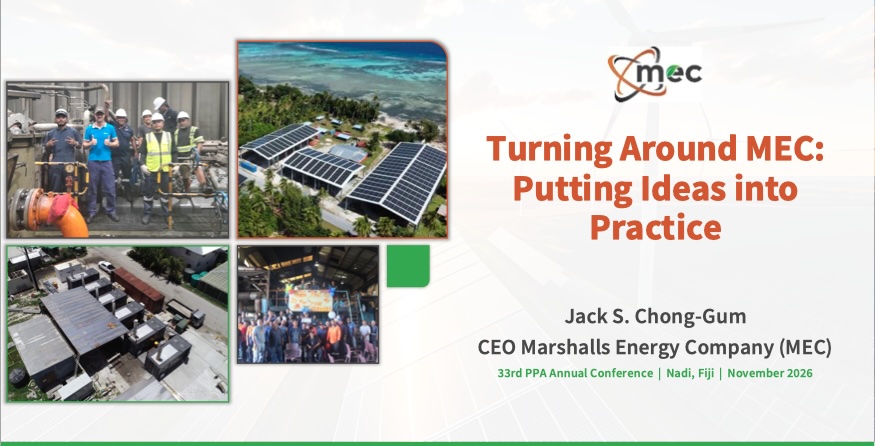
Nadi, Fiji – When MEC CEO Jack Chong-Gum stepped up to speak at the 33rd Pacific Power Association (PPA) Annual Conference, he made a promise to the room of regional utility leaders: “I’m not here to tell anyone how to do it. I’m here to share our story.”
That story, Turning Around MEC: Putting Ideas into Practice, struck a chord. The presentation was well received and appreciated by many delegates, and a number of Pacific utilities asked MEC for a copy.
The PPA is the association of power utilities across the Pacific. Its annual conference brings utility leaders, development partners and suppliers from around the region together to share lessons and plan ahead.
Where we started
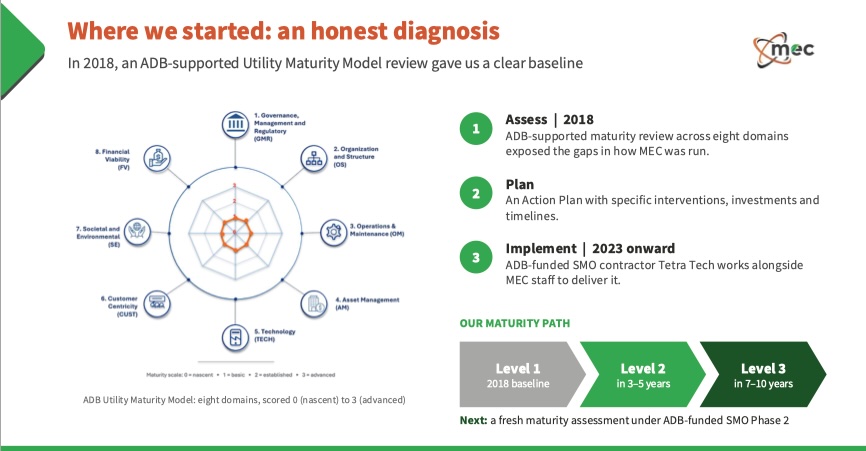
The journey began in 2018, when the Asian Development Bank (ADB) helped MEC take an honest look at itself using a Utility Maturity Model. The results were hard to hear: MEC was at the most basic level in almost every area.
“Nobody enjoys a report card like that,” Mr. Chong-Gum told the audience. “But it gave us something we never had before: a starting point everyone agreed on.”
That diagnosis became a whole-of-utility action plan, delivered with the help of ADB-funded management support from Tetra Tech. More than half of its 20 actions are now complete, including a new sector law, the merger of MEC and KAJUR, which brought Ebeye’s power, water and sewer services under MEC on 1 October 2026, a new solar policy, and the first full tariff review since 2009.
Results that speak for themselves
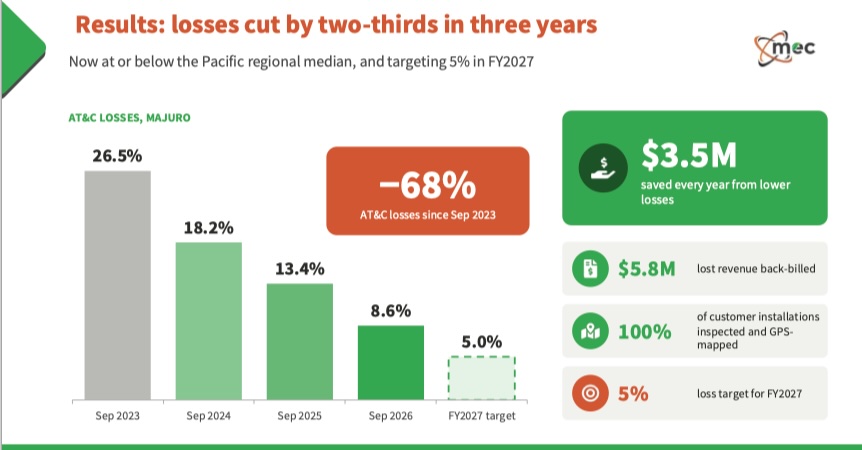
The slide the CEO was proudest of showed MEC’s energy losses. Three years ago, more than one in four units of power MEC produced was never paid for. Today it is fewer than one in ten, a cut of two-thirds.
That turnaround is worth about $3.5 million a year to MEC, and less energy lost means less diesel burned. Mr. Chong-Gum gave the credit to MEC’s own people: a dedicated Revenue Protection team working in the field, house by house and meter by meter, supported by smart meters that show exactly where to look.
His colleague Wayne Kijiner followed with his own presentation, “MEC’s Energy Balance Platform,” showing the tool behind those results followed with a session on MEC’s Energy Balance Platform, the tool behind those results.
Building a secure future
With the basics fixed, MEC is now looking ahead. Its ten-year Integrated Resource and Resilience Plan chooses “least regrets” over “least cost”: options that still make sense whichever way demand, fuel prices or the weather turn.
“For a utility our size, we only make a few big decisions, and each one is huge for us,” the CEO said. “A large utility can absorb one bad bet. We can’t.”
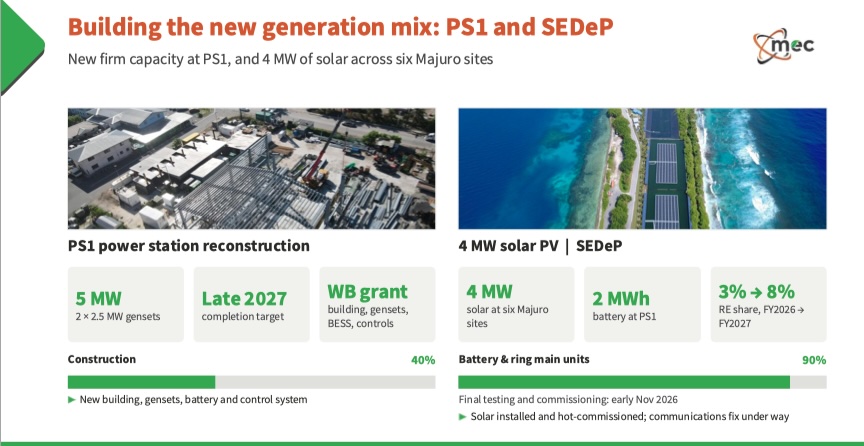
On Majuro, the PS1 power station is being rebuilt from the ground up and is about 40 percent complete, with completion targeted for late 2027. Four megawatts of new solar, funded by the World Bank, is already installed across Majuro, half of it floating on the airport water reservoirs.
What it means for our customers
Alongside PS1, MEC is strengthening the Majuro grid with a digital protection system, a new switching station and new feeders, so that a fault on one line no longer takes down the whole island. The goal is simple: fewer and shorter outages. MEC’s solar policy also keeps the grid stable as solar grows: only solar that MEC operates or contracts can feed power into the Majuro grid, and customer solar systems must have inverters that stop power flowing back into the grid.
The biggest news was REGAIN, a $60 million World Bank grant. Renewables supply about 3 percent of the country’s power today. That rises to about 8 percent once the new solar on Majuro is fully running, and to 29 percent by 2030 with REGAIN. REGAIN will also bring eight solar mini-grids to the outer islands, including four brand-new systems on Arno, which will bring stable power to about 130 homes, schools, clinics and fish bases.
Mr. Chong-Gum also spoke frankly about this year’s fuel shock. When the Strait of Hormuz closed in February, MEC’s April fuel cargo cost $10.8 million, compared with about $4 million before the crisis. “This year changed how we plan,” he said. “Fuel used to be an operations job. Now it is about energy security for our whole country.”
That is why rebuilding MEC’s national tank farm matters so much. Every power plant in the Marshall Islands runs on fuel that passes through it. With all eight tanks restored, bigger fuel cargoes and an emergency reserve, the country could hold more fuel than the 90-day international benchmark for the first time.
Mr. Chong-Gum carried these themes into a panel at the utility CEOs’ retreat during the conference week. The session, “Better Energy Planning Moving Forward,” looked at the energy transition and the aftershocks of the fuel crisis, and he shared how MEC now plans around energy security, not just megawatts.
The question that stayed with the room
The CEO closed with a question that many in the audience will recognize: what happens after the ribbon is cut?
“Every project ends the same way,” he said. “A ribbon is cut, photos are taken, and the contractor and project team move on. Then it is us. For the next 20 years.”
MEC will train its staff during construction, but Mr. Chong-Gum was candid that a few months beside a contractor does not make an expert. He drew on Marshallese tradition to make the point: “Our navigators did not learn from a book handed over at the dock. They sailed beside a master for years, until they could read the waves themselves.”
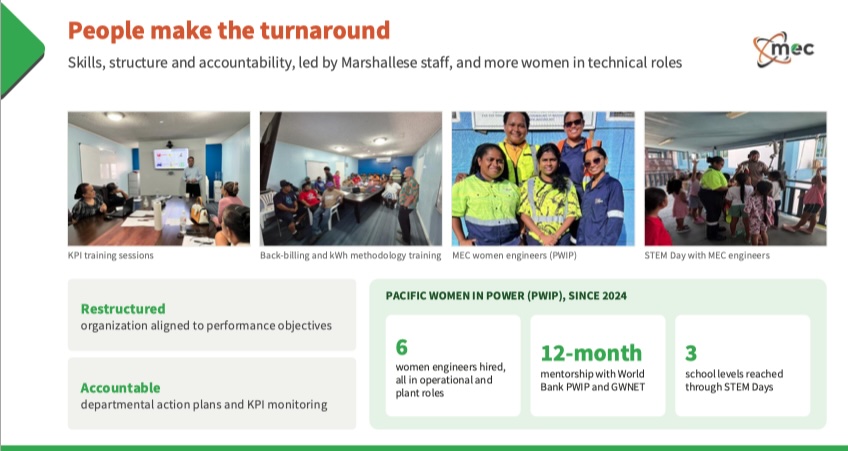
His hope is simple: that every new investment comes with a plan for the people and the money to keep it running, so that these systems are still working, and still Marshallese-run, long into the future. That includes giving women priority for the new jobs REGAIN will bring to the outer islands, building on MEC’s work with Pacific Women in Power.
A team effort
The RMI delegation to Nadi was led by MEC Board member Angeline Heine-Reimers, together with MEC CEO Jack Chong-Gum, Wayne Kijiner and a staff member from the National Energy Authority.
Mr. Chong-Gum closed his presentation by giving credit where it is due. He thanked the Asian Development Bank, the World Bank, the United States Government, the Government of Japan and other development partners for their support, and the Government of the Marshall Islands for standing with MEC through this year’s fuel crisis.
But his warmest thanks went closer to home. “To the MEC team, the men and women who work behind the scenes, in our power plants, out on the lines, and in the field, house by house: you took these plans and made them real, and you put them into practice every single day. This story is yours.”
Kommol tata to everyone at MEC who made this story possible.
About MEC: MEC is the national electric utility of the Republic of the Marshall Islands (RMI), responsible for power generation, transmission, and distribution across the country. MEC is committed to increasing renewable energy penetration and improving energy access for all Marshallese communities. Additionally, MEC is dedicated to helping the RMI achieve its renewable energy and Nationally Determined Contribution (NDC) targets under the Paris Agreement.