

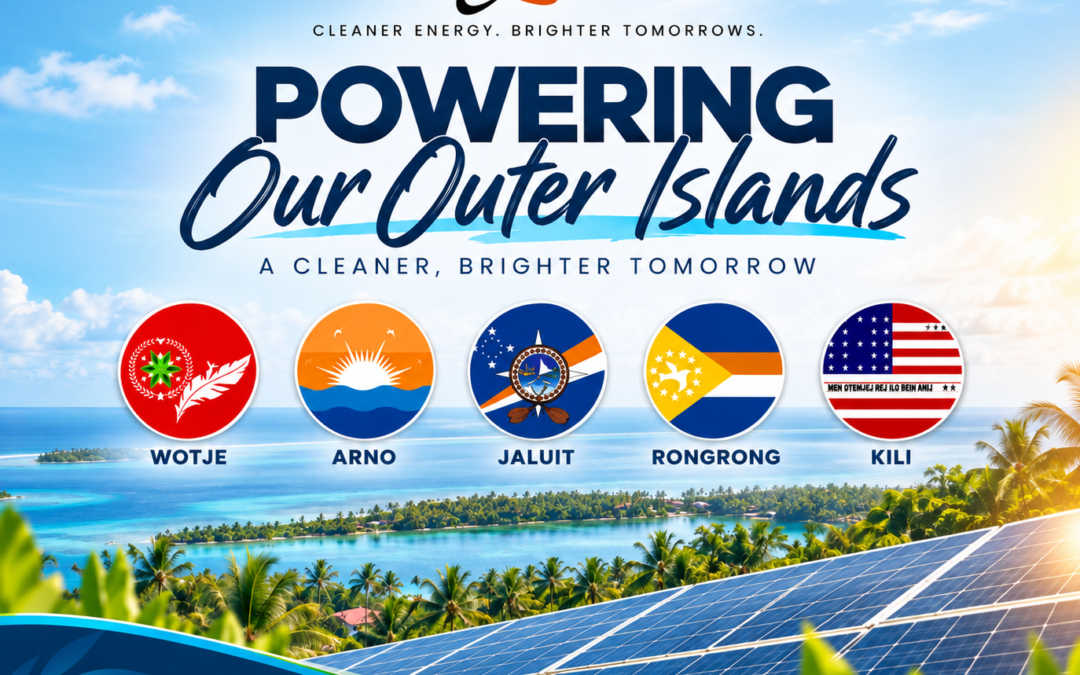
Majuro, Marshall Islands — The Marshalls Energy Company (MEC) has signed a USD 20.5 million construction contract with Sunergise EPC Limited to build solar power systems for seven outer island communities. The contract was executed on 29 October 2026 and is financed by the World Bank under the REGAIN Project.
When MEC last reported on this project in May, the bids had just gone out. Since then the proposals have been evaluated, the terms negotiated, and the contract cleared by the World Bank and signed. The planning is finished. The building starts now.
What Is Being Built, and Where
Seven communities across four atolls will receive solar power, and the work takes two different forms depending on what each place already has.

Arno Atoll gets four entirely new systems. The communities of Arno, Ine, Jabo and Matolen will each receive their own solar mini-grid: panels, battery storage, a backup generator, and poles and lines running to 139 households and the community facilities they share.
Jabor on Jaluit, along with Wotje and Rongrong, gets an upgrade. These three communities already have diesel power stations. Solar panels and large batteries will be added to each, and the aging distribution lines that carry power through the villages will be rebuilt.
Across all seven sites, the project installs more than 6,200 kilowatt-hours of battery storage, sized to each community: 2,520 kilowatt-hours at Jaluit, 2,160 at Wotje, 540 at Arno, 420 at Ine, 240 at Rongrong, 220 at Matolen and 100 at Jabo.
Arno: A Question That Finally Has an Answer
On Arno there is a question that has come up at family gatherings, in council meetings, and on the boat ride home from Majuro for as long as anyone can remember.
We can see the capital from here. Why not us?
Arno sits closer to Majuro than any other atoll in the country — close enough for a morning boat run, close enough that the lights of the capital are part of the view at night. Its four communities have managed with what they had, and their evenings have ended when the light did.
That question is about to stop being a question. Round-the-clock power means ice for the day’s catch, so a fisherman’s work holds its value all the way to market. It means Arno’s guesthouses can finally offer what visitors expect — a fan through the night, cold drinks, a charged phone — and turn a day trip into a week’s stay. It means banking and card payments become possible on an island where residents have had to board a boat to Majuro for them. It means cold storage in the shops, refrigerated medicine in the dispensary, and homework that does not have to be finished before sunset.
MEC has heard that question from Arno for years. We are glad to be bringing an answer.
A Word About Kili
Readers who followed our earlier update will have noticed that Kili Island is not among the seven sites in this contract. Kili has not been set aside, and MEC wants to be clear about why it is not in this package.
When the tender was prepared, Kili’s design work was still at the conceptual stage while the other seven sites were ready to go to market. MEC faced a choice: hold the entire tender until Kili’s design caught up, or take the seven ready communities to bid now and bring Kili in afterward.
We chose not to make Arno, Jaluit, Wotje and Rongrong wait. Holding everything for one site would have pushed construction for all of them months further out, through no fault of those communities.
Kili’s design is now complete. What remains is to negotiate the package with the contractor, and MEC expects those negotiations to begin early next year. The decision was about sequencing, not priority. Kili remains part of REGAIN, and MEC will report on its progress as the negotiations move forward.
Why the Batteries Matter
Solar panels only make power while the sun is shining. The batteries are what turn sunshine into electricity you can use at night.
Think of a battery as a water tank. During the day, when the sun is strong, the panels fill the tank. After dark, the community draws from what was stored. That is how a solar system keeps your lights on at midnight, your refrigerator cold, and your fan running while you sleep.
Cutting the Fuel Bill by Nine-Tenths
MEC ships diesel to Jaluit, Wotje and Rongrong to keep those three power stations running, and the volume is substantial: close to 144,800 gallons a year between them.
Once the solar systems take over, those plants will need only about 16,100 gallons — roughly one gallon for every nine burned today. The difference is more than 128,500 gallons staying out of the fuel boat every year.
Priced at $7 per gallon landed in Majuro, the saving comes to roughly $900,000 annually depicted in the image below:

That money does not disappear when we stop spending it on fuel. It stays in the utility, where it can be put toward service for the communities MEC exists to serve.
There is a second benefit that is harder to put a figure on. Diesel is priced by global markets, and when those markets move, MEC has no choice but to follow. Sunlight carries no invoice and no freight charge. Using more solar power makes our costs less dependent on changing diesel prices, which can help keep electricity rates more affordable for families.
What This Means for Families
Power you can count on. No more waiting for the generator. No more planning your evening around when the lights might go out. Children can study at night. Dispensaries can keep medicines cold. Small businesses can stay open after dark.
Jobs for Marshallese workers. Building seven power systems across four atolls takes people — laborers, electricians, drivers, boat crews, cooks and site workers. The contractor will be hiring locally as construction gets underway, and the skills Marshallese workers gain on this project stay in this country long after the last panel is installed.
Worry-free from the fuel boat. Every gallon burned in our outer islands arrives by ship. When the weather turns or a shipment is late, communities go dark. Solar power is made where it is used, from a resource no one can delay, ration or price out of reach.
Cleaner air and safer waters. Less diesel burned means less smoke, less engine noise, and less risk of fuel spills in the lagoons and reefs our communities depend on for food.
A fairer deal for the outer atolls. Nearly everything costs more away from Majuro, and of all the essentials, electricity has been the least dependable. Our neighboring islands have waited longest for services that others take for granted. This project is MEC putting that right, starting with power.
A Nation Keeping Its Word
The Marshall Islands has spoken plainly to the world about climate change, often more plainly than nations many times our size. Projects like this one are how a country backs up its words. Each system built here is measurable progress toward the renewable energy commitments the RMI has made internationally; delivered not in a conference hall, but on an atoll.
The Work Ahead
Construction is expected to take approximately 18 months. MEC, Sunergise and the project’s technical advisors will visit all sites in the coming weeks to meet community leaders and residents before work begins.
MEC will keep communities informed at every stage. This project is being built for you, and your questions matter to us.
KOMMOL TATA…
To the Government of the Republic of the Marshall Islands — for bringing this financing to our country and securing it. Our leaders fought for these funds with the outer islands in mind, and that is exactly where this project is going.
To the World Bank — for the financing and for the technical support and patience shown throughout a long and demanding process. The Bank’s team worked alongside MEC at every stage.
To Sunergise EPC Limited — for staying at the table through a detailed and difficult negotiation. MEC pushed hard on behalf of our people and Sunergise met us there. We now have a contract both parties can stand behind, and we look forward to building it together.
HON. THOMAS HEINE
Minister of Works, Infrastructure & Utilities
Chairman of the MEC Board of Directors
“When I think about this project, I think about our families. I think of a parent on Ine keeping food fresh, a student on Jaluit studying with confidence that the lights will stay on, and a health worker on Arno keeping medicines safe. These are everyday needs, but meeting them can change lives. Our neighboring island communities deserve to look to the future with the same hope and opportunity as anyone else in our country. This contract is one step toward that future, supporting the Government’s long-term vision of cleaner energy and better access to electricity for all Marshallese. There is still much work ahead, but our purpose is clear: to build a country where the island you call home does not limit the life you can build, or the dreams your children can pursue.”
About MEC: MEC is the national electric utility of the Republic of the Marshall Islands (RMI), responsible for power generation, transmission, and distribution across the country. MEC is committed to increasing renewable energy penetration and improving energy access for all Marshallese communities. Additionally, MEC is dedicated to helping the RMI achieve its renewable energy and Nationally Determined Contribution (NDC) targets under the Paris Agreement.