
Majuro, Marshall Islands – When you need to lift something that weighs as much as a school bus, and position it precisely and safely, you need serious equipment. That’s exactly the challenge MEC faces with two major infrastructure projects currently underway: installing massive new fuel storage tanks for KAJUR on Ebeye and constructing the new PS1 building on Majuro. Without the right lifting equipment, these critical projects simply cannot move forward.
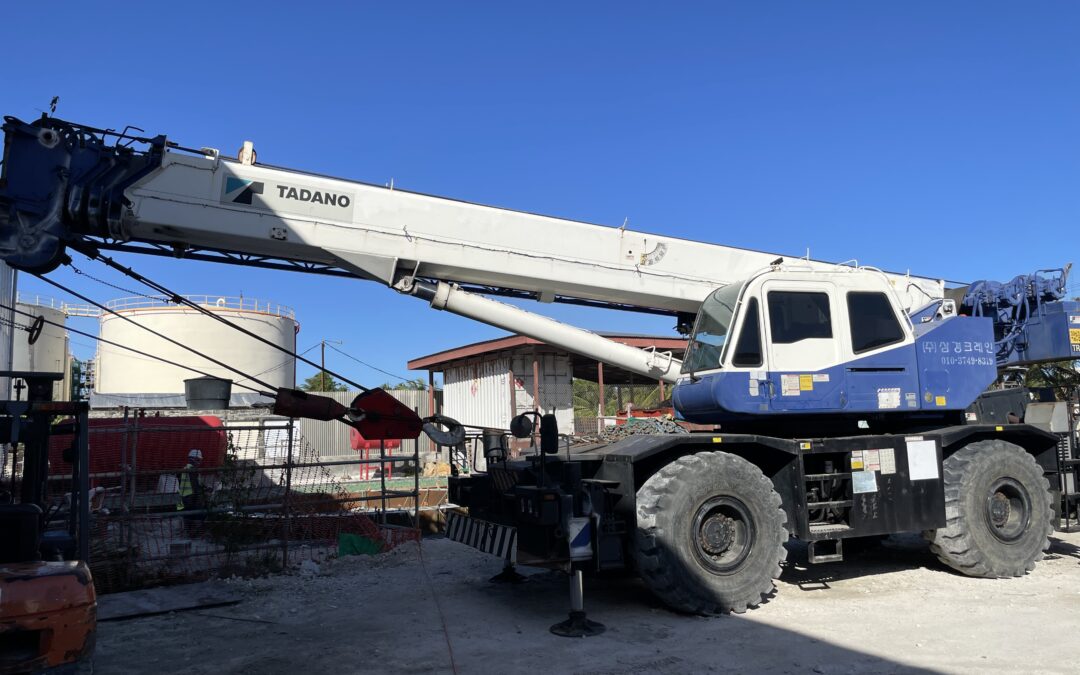
That’s why MEC has acquired a 50-ton crane—a substantial piece of heavy equipment capable of lifting up to 100,000 pounds. This isn’t just a nice addition to MEC’s equipment fleet; it’s an absolute necessity. Without this crane, MEC cannot complete the installation of KAJUR’s new horizontal fuel storage tanks or repair the existing deteriorating tanks. There are no cranes on Ebeye with the capacity to handle this specialized work, making this acquisition essential for project success.
The KAJUR Fuel Crisis That Must Be Solved
To understand why this crane is so critical, you need to understand the fuel storage situation at KAJUR on Ebeye. The power plant currently relies on aging vertical fuel tanks that were originally designed to hold 100,000 gallons each. However, years of use in the harsh marine environment have taken their toll. Corrosion and deterioration have compromised these tanks to the point where they can now safely hold only about 60,000 gallons each—a 40% reduction in capacity!
This degradation creates serious problems. Reduced fuel storage capacity means KAJUR must receive fuel deliveries more frequently, increasing operational complexity and costs. More concerning is the risk: deteriorating tanks could fail catastrophically, potentially causing environmental damage, service disruptions, and safety hazards. These tanks need comprehensive repairs, but they can’t be taken offline for maintenance without replacement capacity, which is where the new horizontal tanks come in.
MEC is assisting KAJUR install the new horizontal fuel storage tanks which will increase KAJUR’s total fuel storage capacity to approximately 350,000 gallons. These modern tanks are designed for long-term durability and efficient fuel management. But here’s the challenge: each of these horizontal tanks is massive—weighing tens of thousands of pounds and requiring precise positioning and installation. Moving and installing equipment of this size and weight demands a crane with exactly the capacity MEC has now acquired.
Once the new horizontal tanks are operational and providing adequate fuel storage, KAJUR can finally take the deteriorating vertical tanks offline for the comprehensive repairs and restoration they desperately need. This phased approach, which will involve installing new capacity first, then repairing existing infrastructure, ensures continuous fuel availability for Ebeye’s power plant while addressing critical maintenance needs.
The benefits extend beyond KAJUR itself. Improved fuel security and increased storage capacity will reduce the frequency of fuel deliveries to the Ebeye power plant. This enhanced fuel infrastructure will also free up MEC’s MERAM vessel to expand its service to the neighboring islands, providing them with much-needed petroleum supplies.
Building the Future: The PS1 Building Project
The 50-ton crane is equally essential for another major project: construction of MEC’s new PS1 building on Majuro. Modern power infrastructure buildings require heavy structural components such as steel beams, large electrical equipment, roofing systems, and other materials that cannot be safely or efficiently positioned without proper lifting equipment.
The PS1 building will house critical electrical assets that will modernize and improve power services on Majuro. One of the most demanding aspects of this project is the installation of new generators inside the building. These generators are massive pieces of equipment that must be lifted and precisely positioned within the building structure. The 50-ton crane provides the capacity needed to safely lift these generators and maneuver them into their exact operational positions inside the PS1 building.
Beyond generator installation, constructing this facility involves lifting and precisely positioning heavy structural elements, electrical switchgear, transformers, and other equipment at various heights and angles. The 50-ton crane provides the capacity and control needed to accomplish all of this work safely and efficiently, ensuring that the building meets all structural and safety requirements.
Without this crane, construction would either be impossible or would require expensive alternatives like bringing in rental equipment from overseas—a costly and logistically complex option that would significantly delay the project and inflate costs.
A Strategic Investment in Long-Term Capability
This crane acquisition represents more than just equipment for two specific projects—it’s a strategic investment in MEC’s long-term capability to execute major infrastructure work. The Marshall Islands’ remote location makes it extremely expensive and time-consuming to bring in specialized heavy equipment for every major project. By owning a 50-ton crane, MEC gains the ability to:
- Execute critical infrastructure projects on its own timeline
- Respond quickly to emergency situations requiring heavy lifting capacity
- Reduce costs by eliminating expensive equipment rental and shipping
- Support future projects across both Majuro and Ebeye
- Maintain greater control over project quality and safety
The crane will remain a valuable asset long after the current fuel tank and PS1 building projects are complete, supporting ongoing maintenance, future construction, and infrastructure improvements throughout MEC’s service territory.
Moving Critical Projects Forward
With the crane now acquired, both the KAJUR fuel tanks installation and the PS1 building construction can proceed without unnecessary delays. For KAJUR customers on Ebeye, this means progress toward more reliable fuel supply and reduced risk from aging infrastructure. For Majuro, it means advancement of critical electrical infrastructure improvements.
These projects build on earlier phases of infrastructure development and represent MEC’s continued commitment to strengthening the energy sector across the Marshall Islands. Reliable power depends on reliable infrastructure—from fuel storage to buildings to distribution systems—and investments like this crane acquisition make it possible to build and maintain that infrastructure to professional standards.
The path from acquiring a crane to completing fuel tanks and buildings may seem indirect, but in infrastructure development, having the right tools isn’t optional. It’s fundamental!
Updates on the KAJUR fuel tanks installation and repairs and the PS1 building construction will be shared as these projects progress on the MEC website at www.mecrmi.com.