
Majuro, Marshall Islands – The Marshalls Energy Company (MEC) is pleased to provide an update on the REGAIN Project, specifically Component 2: Improved Electricity Access in Outer Atolls, which is now in its final stages of tendering, with construction expected to begin later this year.
The project will bring solar power to communities across five outer islands: Arno, Jaluit, Wotje, Rongrong, and Kili.
What is the REGAIN Project?
REGAIN stands for Renewable Energy Generation and Access INcrease. Funded by the World Bank and implemented by MEC, the project was born out of a simple but urgent truth — people living on the outer islands pay some of the highest costs of living in the country. Food is more expensive. Fuel for boats is more expensive. And reliable electricity has never been guaranteed. For too long, outer island communities have depended entirely on diesel generators, leaving them vulnerable to fuel shortages, rising fuel prices, and power outages that affect daily life, businesses, and essential services.
The REGAIN Project aims to change that. By replacing most of the diesel generation with solar panels and battery storage, these communities will become far less dependent on fossil fuels. Less fuel burned means lower operating costs for MEC — and lower operating costs should mean lower electricity tariffs for the people who need it most. Combined with more reliable and consistent power supply, the project is about giving outer island families and businesses a better quality of life and a more secure energy future.
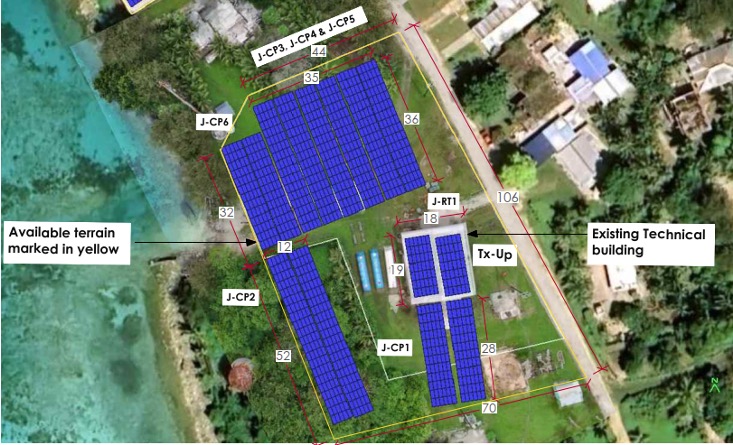
For Arno, the project will build brand new solar mini-grids for four communities — Arno, Ine, Jabo, and Matolen — serving 139 households and community facilities. For Jaluit, Wotje, and Rongrong, the existing diesel power plants will be upgraded with solar panels and batteries — a process called hybridization. Kili Island is also included in the project and will follow under the same construction contract once its design is finalized.
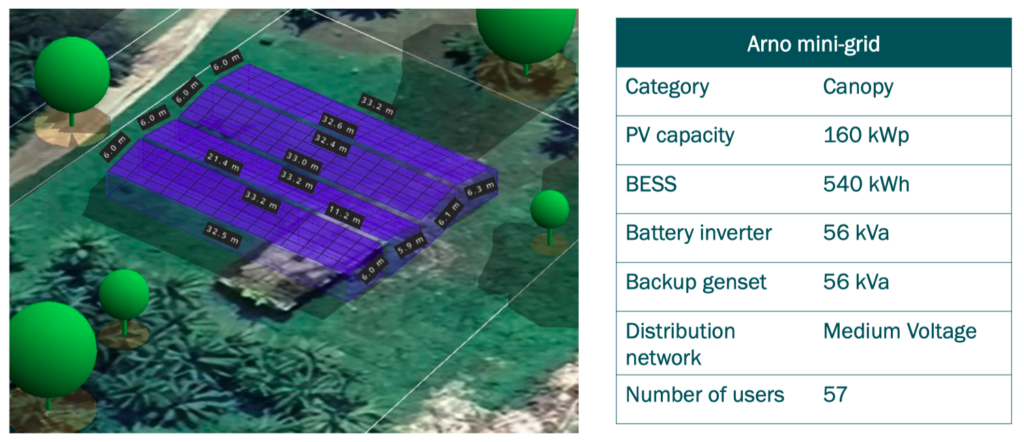
Concept design and operating information of proposed solar PV system at Arno, Arno Atoll
The Tendering Process — Where Are We Now?
Bids were sent to selected companies on 7 April 2026, and companies have until 21 May 2026 to submit their proposals. MEC and its partners will then evaluate all bids through early June. A contract is expected to be awarded and signed by late June 2026, with construction to follow shortly after.
Saving Fuel, Saving Money
The numbers tell a compelling story. The power plants in Jaluit, Wotje, and Rongrong currently burn through nearly 144,800 gallons of diesel every year. Once the solar systems are up and running, that number drops to just over 16,100 gallons, a reduction of more than 128,500 gallons annually. At current fuel costs of $7 per gallon landed in Majuro, that translates to approximately $900,000 in fuel savings for MEC every year.
The savings break down as follows:
- Jaluit: ~$460,000/year
- Wotje: ~$392,000/year
- Rongrong: ~$47,000/year
These are real dollars that can be reinvested into improving electricity services for out island communities.
“The fuel crisis has hit us hard, and every dollar we spend on diesel is a dollar that cannot go toward improving our service to the people who depend on our services,” said MEC’s CEO. “These solar projects are not just about clean energy. They are about financial survival and energy security for our island communities. We are proud to be moving into this final stage and we look forward to breaking ground later this year.”
What This Means for Island Communities
For families on these islands, this project is about more than just electricity. It means power that stays on when diesel supply chains are disrupted. It means lower costs that can ease the financial burden on households already stretched by the high cost of living. And it means a future where communities are no longer at the mercy of fluctuating global fuel prices.
About MEC: MEC is the national electric utility of the Republic of the Marshall Islands (RMI), responsible for power generation, transmission, and distribution across the country. MEC is committed to increasing renewable energy penetration and improving energy access for all Marshallese communities. Additionally, MEC is dedicated to helping the RMI achieve its renewable energy and Nationally Determined Contribution (NDC) targets under the Paris Agreement.