
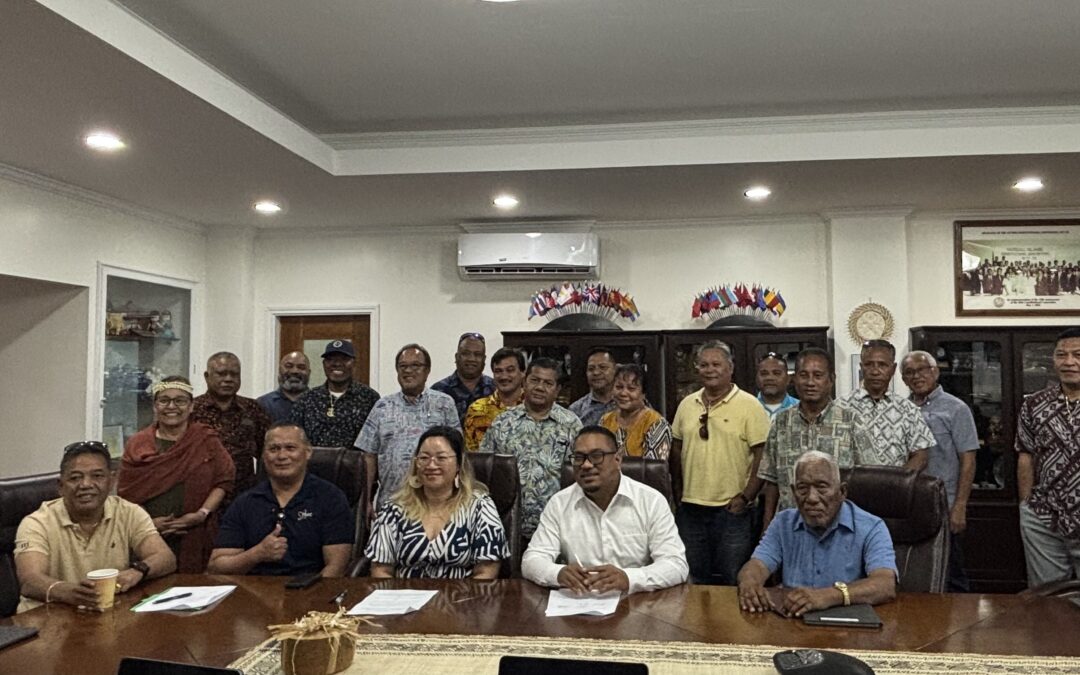
Majuro, Marshall Islands – On October 15, 2025, government officials, representatives from Kili/Bikini/Ejit Local Government (KBE), and MEC leadership gathered at Cabinet to sign the official transfer agreement that brings Kili Power Services under MEC’s operational responsibility. This milestone marks the beginning of a significant effort to improve electrical infrastructure and service reliability for the Kili Island community.
A New Chapter for Kili Power
For years, Kili Island’s power system has operated independently under KBE’s management. While this arrangement served the community, the challenges of maintaining a small, isolated power system have been substantial. Limited resources and the unique difficulties of operating power infrastructure on a remote outer island have affected service reliability and system performance.
With this transfer, MEC brings its institutional expertise, technical resources, and operational capacity to support Kili’s power needs. The transition aligns with MEC’s mandate to provide equitable and dependable energy access across the Republic of the Marshall Islands, ensuring that outer island communities receive the same level of professional power service management as Majuro.
Getting to Work: Equipment Already on Its Way
MEC isn’t waiting to begin improvements. Distribution equipment is already being prepared and shipped to Kili Island, including:
- Utility poles for rebuilding and upgrading the distribution network
- Transformers to ensure proper voltage regulation and power quality
- Vacuum circuit breakers (VCBs) for modern, reliable electrical protection
- Pre-paid meters to provide customers with better control over their electricity usage and payments
This initial equipment shipment represents the first phase of what will be an extensive infrastructure improvement program. MEC teams conducted a detailed assessment of Kili’s complete electrical system several months ago, well before the official transfer ceremony. That assessment identified exactly what needs to be replaced and repaired, allowing MEC to develop a comprehensive improvement plan. Now, with the transfer officially complete, MEC is moving from planning to implementation—getting the necessary equipment to the island and beginning the substantial work of bringing Kili’s power infrastructure up to modern standards.
Setting Realistic Expectations: This Will Take Time
It’s important for the Kili community to understand that significant improvements won’t happen overnight. The current state of Kili’s electrical infrastructure requires substantial work. Old generators need to be replaced, distribution lines must be rebuilt in many areas, safety systems need upgrading, and numerous other improvements are necessary to establish a truly reliable power system.
Think of it like renovating an old house. You can’t just paint over problems. The foundation needs to be solid, the wiring must be safe and adequate, and critical systems have to work properly before you can enjoy a comfortable, reliable home. The same principle applies to Kili’s power system.
MEC is committed to doing this work properly, which means taking the time necessary to make lasting improvements rather than quick fixes that won’t solve underlying problems. Generator replacement alone is a major undertaking that requires careful planning, significant investment, and coordination of shipping and installation logistics to a remote location.
What This Means for Kili Residents
In the near term, Kili residents should expect to see MEC crews implementing improvement work as equipment arrives and projects get underway.
Beyond the immediate infrastructure improvements, this transfer also opens an important door for Kili’s energy future. With MEC now managing Kili’s power services, the island becomes eligible for World Bank grant funding designated for renewable energy projects. This means Kili can access resources to install solar photovoltaic (PV) panels, dramatically improving the island’s energy resilience.
Solar PV systems would reduce Kili’s dependence on diesel fuel, which must be shipped from Majuro at significant cost and can be subject to supply disruptions. More importantly, solar power provides a local, sustainable energy source that makes the island less vulnerable to fuel shortages and supply chain challenges. Combined with properly maintained backup generators, a solar-plus-storage system could transform Kili’s power reliability while lowering long-term operating costs.
Over the longer term, as generators are replaced, distribution systems are upgraded, solar panels are installed, and operational practices are improved, the Kili community can look forward to more reliable power service, better response to technical issues, cleaner energy production, and professional management of the electrical system.
MEC understands that reliable electricity isn’t a luxury. It’s essential for preserving food, enabling communication, supporting livelihoods, and maintaining quality of life. The commitment to Kili is the same commitment MEC makes to all the communities it serves: dependable power delivered professionally and sustainably.
Moving Forward Together
This transition represents a significant commitment from President Hilda Heine’s Cabinet and a new partnership with the Kili community. Success will require patience as substantial infrastructure improvements take shape, but also active communication between MEC and Kili residents to ensure that local needs and concerns are heard and addressed.
MEC will continue to provide updates as integration activities progress, equipment arrives, and improvement projects advance. The road ahead involves considerable work, but it’s a path toward better, more reliable power service that the Kili community deserves.
For a small island community that has managed its own power system for years, this change is significant. MEC is honored to take on this responsibility and committed to earning the community’s trust through consistent, professional service and meaningful infrastructure improvements.
Further updates on Kili power system improvements will be shared as projects progress. Questions about the transition can be directed to MEC through normal customer service channels or by visiting our website at www.mecrmi.com.