

Majuro, Marshall Islands – If you’ve experienced an unplanned power outage in recent weeks, there’s a strong chance it was caused by something simple but persistent: a tree branch touching an overhead power line. From early morning outages that last most of the day to brief interruptions that disrupt work and home life, vegetation contact with power lines has become one of the most common causes of unplanned outages on Majuro.
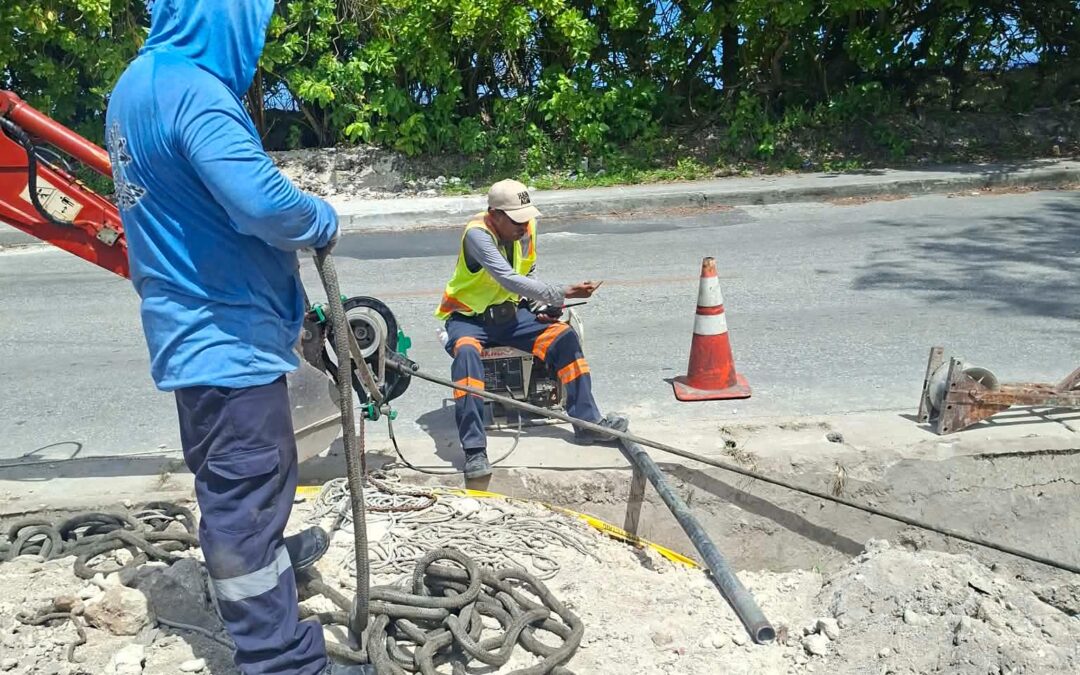
MEC is taking aggressive action to change this. As part of a broader campaign to dramatically reduce tree-related outages, MEC has begun work on a major new underground power cable project running between the Ministry of Public Works and the Majuro Bridge. This project represents a significant investment in long-term reliability, and it’s just one piece of MEC’s larger strategy to deliver the safe, dependable power service our customers deserve.
The Tree Problem: Why It Matters
Trees and power lines don’t mix well, but on a tropical island where vegetation grows quickly year-round, keeping them apart is a constant battle. In recent weeks, falling branches and trees making contact with
overhead lines have caused numerous unplanned outages across Majuro. Some of these outages have lasted hours, requiring crews to work through rain, wind, and long shifts to safely restore service. The challenge is significant because:
• Trees grow continuously – What was a safe distance yesterday may be too close tomorrow
• Weather changes everything – Wind shifts can push previously safe branches into power lines
• Storms create new hazards – Heavy rain and wind can break branches that wouldn’t normally fall
• Trimming alone isn’t enough – With limited tree trimming crews and miles of overhead lines across Majuro, MEC can’t keep up with vegetation growth in every location
This reality has driven MEC to take a more aggressive, comprehensive approach to the problem.
The Underground Solution
The new underground cable project between the Ministry of Public Works and the Majuro Bridge tackles the tree problem in the most direct way possible: by removing power lines from harm’s way entirely. When power cables are buried underground, they become essentially immune to:
• Falling tree branches
• Wind damage
• Vegetation growth
• Severe weather
• Accidental contact
This corridor was chosen strategically because of two significant safety concerns. First, the area is lined with many tall trees, including pine trees, along the main road, creating ongoing risks of branches contacting the overhead power lines. Second, several building roofs in the area now sit dangerously close to the overhead lines, presenting serious safety and fire hazards.
It is important to note that the overhead power lines existed in this area long before the surrounding buildings were constructed. However, due to the lack of a building code at the time of construction, property owners built their structures directly underneath the overhead lines despite repeated objections from MEC. By moving these lines underground, MEC eliminates a safety hazard that has persisted for years.
A Significant Investment for a Real Solution
Underground cable installation is not a quick fix or a cheap solution. The work requires:
• Excavation of the entire cable route
• Specialized cables designed for underground installation
• Protective conduits to shield the cables from damage
• Skilled technical work to ensure proper installation and connections
• Significant funding that far exceeds the cost of overhead lines
This investment of time and money reflects MEC’s commitment to genuine, long-term solutions rather than temporary patches. While it would be faster and cheaper to simply trim trees and replace damaged overhead lines as they occur, that approach hasn’t delivered the reliability our customers deserve. The underground cable project represents a permanent solution that will benefit Majuro for decades to come.
Part of a Larger Campaign
This project is one important piece of MEC’s broader campaign to reduce unplanned outages. Other elements of this campaign include:
• Expanded tree trimming efforts with the goal of reviving joint partnerships with the Government and Majuro Mayor’s office
• Targeted underground conversion in areas where large trees cannot be practically removed
• Backup generators at network endpoints like Laura (already operational) and Jenrok (planned) to maintain service when feeder outages occur
• Continuous distribution system upgrades to improve overall reliability
Together, these initiatives represent MEC’s most aggressive effort yet to address the root causes of unplanned outages. The goal is simple: fewer outages, shorter outages, and faster restoration when outages do occur.
Our Commitment to You
We know that unplanned outages disrupt your lives. They affect your refrigerated food, your work, your studies, your businesses, and your peace of mind. We’ve heard your concerns, we’ve worked through the long nights of restoration alongside our crews, and we share your frustration with how often trees have caused problems on our system.
This underground cable project, and the broader campaign it represents, is MEC’s response to that frustration. It’s not the cheapest option. It’s not the fastest option. But it’s the option that delivers the reliable, safe power service you deserve.
We are committed to seeing this work through, even as it requires significant investment of time and money. Our customers, such as the families, businesses, schools, and institutions that depend on MEC, are
worth that investment.
We thank you for your patience as we undertake this important work, and we look forward to delivering the improved reliability that will result from these efforts.
About MEC: MEC is the national electric utility of the Republic of the Marshall Islands (RMI), responsible for power generation, transmission, and distribution across the country. MEC is committed to increasing renewable energy penetration and improving energy access for all Marshallese communities. Additionally, MEC is dedicated to helping the RMI achieve its renewable energy and Nationally Determined Contribution (NDC) targets under the Paris Agreement.